



Whether you are a psychology student or simply trying to understand why you react the way you do to certain triggers, understanding the difference between classical vs. operant conditioning is fundamental. These two pillars of behaviorism explain how we learn from our environment — one through association and the other through consequences. In this guide, we break down the mechanics of each, compare classical and operant conditioning side by side, and explore how both are applied in modern mental health treatment.
The Core Difference of Classical Vs Operant Conditioning
Classical conditioning is passive learning through association. Your brain automatically links two things together, creating involuntary responses. You don’t choose to feel anxious when you hear a dentist’s drill—it just happens because your brain associated that sound with discomfort.
Operant conditioning is active learning through consequences. Your voluntary behaviors are shaped by what happens afterward—rewards encourage repetition, while punishments discourage it. For example, you exercise regularly because you feel energized afterward, or stop checking your phone at dinner because your partner asked you to.
In this guide, we’ll explore operant and classical conditioning differences with real-world examples and show how these principles apply to therapy, parenting, and daily life.
Understanding Behavioral Learning: An Overview
Classical and operant conditioning are the two foundational models of behavioral learning. Together, operant and classical conditioning explain how humans and animals adapt their behavior based on experience. Classical conditioning works through association — pairing a neutral stimulus with a meaningful one until a response is triggered automatically. Operant conditioning works through consequences — using reinforcement and punishment to increase or decrease voluntary behaviors.
Both models were developed in the early 20th century and remain central to psychology, therapy, and education today.
What is Classical Conditioning? (Respondent Learning)
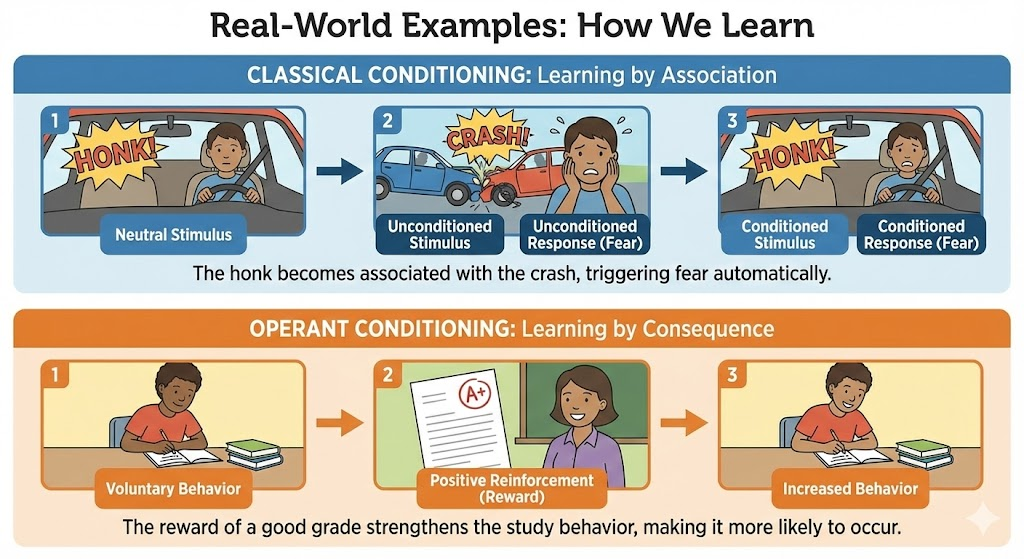
Classical conditioning centers around associations. Pavlov’s experiment with dogs famously illustrated how a neutral stimulus, like a bell, when repeatedly paired with an unconditioned stimulus, like food, can eventually trigger a conditioned response, such as salivation. This automatic response becomes wired into behavior without conscious effort.
The Pavlovian Model: UCS, UCR, CS, and CR
Pavlov’s model uses four key terms that appear throughout psychology and therapy:
• Unconditioned Stimulus (UCS): A stimulus that naturally produces a response — e.g., food producing salivation.
• Unconditioned Response (UCR): The natural, unlearned reaction to the UCS — e.g., salivating at food.
• Conditioned Stimulus (CS): A previously neutral stimulus that, after pairing, triggers a response — e.g., a bell.
• Conditioned Response (CR): The learned response to the CS alone — e.g., salivating at the bell.
Understanding these four components is essential for grasping how classical conditioning underpins treatments like exposure therapy for phobias and anxiety.
What is Operant Conditioning? (Instrumental Learning)
Operant conditioning is about consequences. B.F. Skinner’s work showed how behaviors are shaped by reinforcement and punishment. A child praised for doing homework is more likely to repeat the behavior, while one scolded for drawing on walls may learn to stop.
The Skinner Box and the Law of Effect
B.F. Skinner’s work built on Edward Thorndike’s Law of Effect — the principle that behaviors followed by satisfying outcomes are more likely to be repeated, while those followed by unpleasant outcomes are less likely to recur. Skinner’s controlled environment, known as the Skinner Box, allowed him to observe precisely how reinforcement schedules affected the speed and persistence of learned behavior.
Skinner identified that intermittent reinforcement — rewarding a behavior only sometimes — produces the most resistant-to-extinction learning pattern. This is the same mechanism behind gambling and social media scrolling.
Both types appear in everyday life, therapy techniques, and classroom systems—influencing everything from our emotional reactions to our daily habits.
Reinforcement and Punishment: The Four Quadrants
To fully understand operant vs. classical conditioning, it helps to master operant conditioning’s four quadrants. A common misconception is that “negative” means bad — it simply means removing something.
Positive Reinforcement: Adding something desirable to increase a behavior. Example: praising a child for completing their homework.
Negative Reinforcement: Removing something unpleasant to increase a behavior. Example: taking aspirin to stop a headache — the pain relief reinforces taking the pill.
Positive Punishment: Adding something unpleasant to decrease a behavior. Example: receiving a speeding ticket.
Negative Punishment: Removing something desirable to decrease a behavior. Example: taking away a teenager’s phone for breaking curfew.
Remember: reinforcement always aims to increase a behavior. Punishment always aims to decrease it. The positive/negative labels only describe whether something is added or removed.
Classical vs. Operant Conditioning: 5 Core Differences
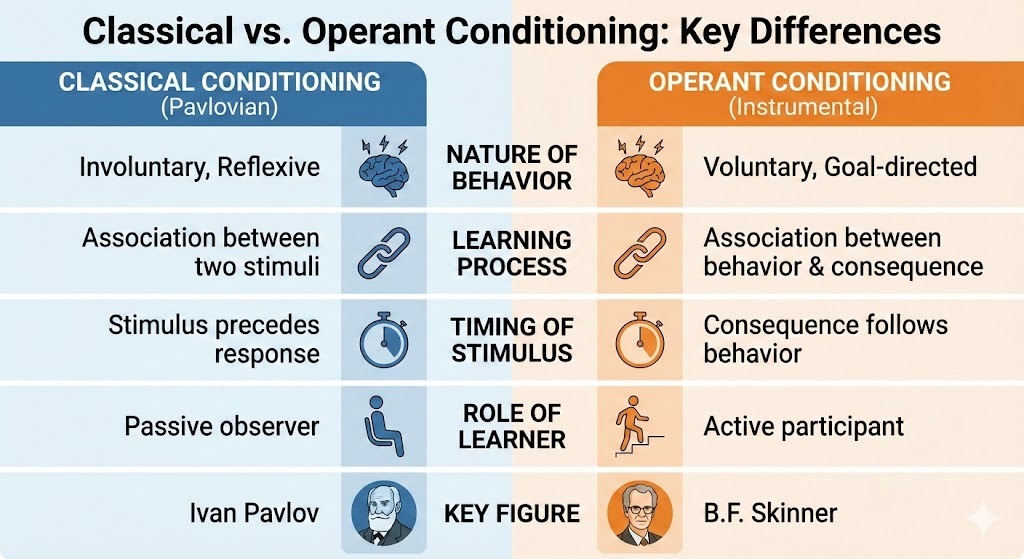
Type of Learning: Classical = learning through association. Operant = learning through consequences.
Role of the Learner: Classical = passive and involuntary. Operant = active and voluntary.
Response Type: Classical = reflexive and automatic. Operant = purposeful and emitted.
Timing: Classical = stimulus precedes the response. Operant = consequence follows the behavior.
Key Researchers: Classical = Ivan Pavlov, John B. Watson. Operant = B.F. Skinner, Edward Thorndike.
Everyday Example (Classical): Feeling nauseous at the smell of a food that once made you sick.Everyday Example (Operant): Working harder at a job to earn a monthly bonus.
Reinforcement Schedules: Why Consistency Matters
• Continuous Reinforcement: Every correct behavior is rewarded. This produces the fastest learning but is the quickest to extinguish when rewards stop.
• Intermittent (Partial) Reinforcement: Behaviors are rewarded only sometimes. This produces slower but far more durable learning — and is the mechanism behind gambling and compulsive phone checking.
For parents, teachers, and therapists, understanding which schedule to apply is as important as the reinforcement itself.
Key Differences Between Classical and Operant Conditioning
| Aspect | Classical Conditioning | Operant Conditioning |
| Type of Learning | Learning by association | Learning by consequence |
| Learner’s Role | Passive (automatic response) | Active (voluntary behavior) |
| Timing | Stimulus comes BEFORE response | Consequence comes AFTER behavior |
| Response Type | Involuntary and automatic | Voluntary and intentional |
| Key Process | Pairing a neutral stimulus with a meaningful stimulus | Linking behavior with reward or punishment |
| Famous Example | Pavlov’s dog salivates at bell sound | Skinner’s rat presses the lever for food |
| Real-Life Example | Feeling anxious hearing the dentist drill | Studying harder after receiving praise |
| Therapy Application | Exposure therapy for phobias | Behavioral activation for depression |
Clinical Applications in Mental Health and Therapy
Treating Phobias with Exposure Therapy (Classical Conditioning)
Classical conditioning explains how phobias develop — a neutral stimulus becomes associated with fear through one or more traumatic pairings. Exposure therapy works by reversing this process through counter-conditioning. Gradual, repeated exposure to the feared stimulus in a safe context weakens the conditioned fear response over time. This approach is central to treating anxiety disorders, PTSD, and phobias at Treat Mental Health.
Behavior Modification and Token Economies (Operant Conditioning)
Operant conditioning principles are used directly in behavior modification programs, particularly for children with ADHD, autism spectrum disorder, and learning difficulties. Token economies reward target behaviors with tokens that can be exchanged for privileges — a direct application of positive reinforcement. These systems are used in clinical, school, and residential treatment settings.
Conditioning in Parenting and the Classroom
Both classical and operant conditioning play out daily in homes and schools. A child who associates a teacher’s calm voice with safety is experiencing classical conditioning. A student who studies harder after receiving praise is experiencing operant conditioning.
Effective parenting strategies for ADHD, for example, rely heavily on consistent positive reinforcement and clear consequences — direct applications of operant conditioning principles. Understanding these mechanisms helps parents and educators shape behavior intentionally rather than accidentally.
Stimulus and Response: The Building Blocks of Learning
Every learned behavior—pulling your hand from heat or checking your phone at a notification—begins with a stimulus and response. These elements form the foundation of both classical and operant conditioning and define how we react to our environment.
In classical conditioning, the stimulus comes first, eventually triggering an involuntary response. In operant conditioning, the focus is on the consequence following a response, which reinforces whether the behavior repeats.
Key points about stimulus-response patterns:
- A stimulus is any event that evokes a response (sound, sight, action)
- A response is the behavior triggered by that stimulus
- Repeated pairings make the connection automatic
- Stimuli can be internal (thoughts) or external (bells, commands)
- Responses can be reflexive (flinching) or learned (typing a password)
- The strength of learned behavior depends on the frequency and consistency of pairing
How Association Drives Behavioral Conditioning
Associations form the core of behavioral learning. Whether a pet expects treats after hearing a jar open or someone feels anxious before public speaking, these connections teach us what to expect and how to act.
In classical conditioning, associations occur when a neutral stimulus is paired with something meaningful. In operant conditioning, the association forms between behavior and its consequence.

Examples of association in action:
- Pairing a sound with food creates a conditioned response (dog salivates to bell)
- Consistently rewarding a child after homework builds a positive behavior loop
- Negative outcomes (headache after loud noise) teach avoidance
- Emotional associations form, like fear linked with specific situations
- With repetition, associations strengthen and become harder to unlearn
Examples in Everyday Life
Classical Conditioning Examples:
Food Aversions: Get sick after eating something? Your brain creates an automatic aversion, even if the food wasn’t the cause.
Emotional Responses to Sounds: An ex’s ringtone triggers anxiety months after a breakup because your brain paired the sound with emotional distress.
Morning Coffee Ritual: Feeling alert from just smelling coffee brewing—your body anticipates the caffeine before you drink it.
Test Anxiety: Feeling nervous entering a classroom where you previously took difficult exams.
Operant Conditioning Examples:
Parenting: A child cleans their room and earns stickers toward a park trip—positive reinforcement strengthens the behavior.
Workplace Bonuses: Sales teams work harder during bonus months because extra effort leads to extra income.
Exercise Habits: You return to the gym regularly because you feel energized afterward—the positive outcome reinforces the behavior.
Traffic Routes: After getting stuck on Main Street three times, you switch to Elm Street—punishment decreased one behavior while relief reinforced the new route.
Reinforcement in Operant Conditioning: Positive Vs Negative
In operant conditioning, reinforcement increases the likelihood of behavior repetition. But reinforcement isn’t always about rewards—sometimes it’s about removing something unpleasant.
| Type of Reinforcement | Definition | Example |
| Positive Reinforcement | Adding a desirable stimulus to increase behavior | Giving a dog a treat for sitting on command |
| Negative Reinforcement | Removing an unpleasant stimulus to increase behavior | Turning off loud music when homework is done |
The Role of Punishment in Shaping Behavior
Where reinforcement increases behavior, punishment decreases it. Punishment introduces consequences that discourage repetition, but must be used carefully—too harsh or inconsistent, and it may backfire.
Key concepts about punishment:
- Positive punishment adds an unpleasant outcome (scolding) to reduce behavior
- Negative punishment removes something desirable (screen time) to reduce behavior
- The goal is behavior suppression, not retaliation—consistency matters
- Punishment works best when paired with reinforcement for desired behaviors
- Overuse without positive strategies can lead to anxiety or mistrust
How Consequences Influence Learning Outcomes
Every consequence sends a message: “Do this again” or “Avoid this next time.” Through this feedback loop, behavior is shaped, solidified, or extinguished.
How consequences drive learning:
- Immediate feedback strengthens the behavior-consequence link
- Clear, predictable consequences build trust and understanding
- Reinforcement encourages repetition; punishment discourages recurrence
- Variable rewards (surprise praise) can motivate more than fixed ones
- Intentional consequences guide long-term behavior patterns
Practical Applications: Real-World Uses
Understanding classical vs operant conditioning shapes therapeutic approaches, educational strategies, and personal development.
Mental Health and Therapy
Classical Conditioning Applications:
- Exposure therapy for phobias gradually presents feared stimuli in safe contexts, breaking the fear association
- Systematic desensitization pairs relaxation with anxiety triggers, helping those with anxiety disorders
Operant Conditioning Applications:
- Behavioral activation for depression encourages activities that bring joy, creating positive reinforcement loops
- Token economy systems in intensive outpatient programs reward treatment engagement
- CBT helps identify behaviors leading to positive outcomes
Education and Parenting
In Classrooms:
- Positive reinforcement: praise, gold stars, extra recess for completed work
- Creating positive associations with subjects through engaging early experiences
- Token economies where class points lead to group rewards
In Parenting:
- Bedtime routines signal sleep time (classical)
- Sticker charts and privileges reward good behavior (operant)
- Consistency is key—random consequences confuse learning and create anxiety
Self-Improvement
Apply these principles to change your own behavior:
- Create routines that trigger desired mental states (classical)
- Track progress and celebrate small wins (operant)
- Change environments to break unwanted associations
- Use habit stacking: reward yourself after completing desired behaviors
Real-Life Comparison
| Situation | Classical Conditioning | Operant Conditioning |
| Training a Dog | Dog salivates at bell associated with food | Dog sits and gets treat for doing so |
| Child in School | Student feels anxious hearing school bell before test | Student earns extra playtime for completing homework |
| Workplace Behavior | Feeling stressed entering meeting room due to past conflicts | Employee gets bonus for meeting quarterly goals |
| Daily Habits | Craving coffee when smelling it brewing | Making bed daily to avoid parents’ scolding |
| Emotional Responses | Feeling happy hearing song associated with good memories | Avoiding traffic routes after repeated delays |
Understanding Classical and Operant Conditioning: Your Path Forward
Whether you’re a student, parent, or someone interested in personal growth, grasping the classical and operant conditioning differences empowers you to understand why we do what we do.
Key distinctions to remember:
Classical conditioning shapes automatic, involuntary responses through association—emotional reactions, phobias, comfort responses happen passively.
Operant conditioning molds voluntary behaviors through consequences—work habits, social behaviors, and skill development happen actively through reinforcement and punishment.
Both surround us daily, influencing emotions, decisions, habits, and relationships. Understanding these principles opens pathways to change. If you struggle with anxiety, phobias, or unwanted patterns, evidence-based therapies rooted in conditioning can help.
At Treat Mental Health, we apply these scientifically-proven concepts through exposure therapy, behavioral activation, and CBT to help clients overcome anxiety, depression, PTSD, and more.
Ready to explore how these principles can support your mental health journey? Contact Treat Mental Health or verify your insurance to get started.
Common Misconceptions About Classical and Operant Conditioning
• Negative reinforcement is NOT punishment. Reinforcement — positive or negative — always increases behavior. Punishment always decreases it.
• Classical conditioning is not just about animals. Human emotional responses, cravings, and phobias are all rooted in classical conditioning.
• Operant conditioning is not manipulation. It is a natural learning process that occurs whether we are conscious of it or not.
• Both types of conditioning can happen simultaneously. A person may feel fear (classical) and then avoid a situation (operant) in the same moment.
Frequently Asked Questions
What is the main difference between classical and operant conditioning?
The main difference is that classical conditioning involves involuntary, automatic responses triggered by a stimulus, while operant conditioning involves voluntary behaviors shaped by their consequences. Classical conditioning is about association; operant conditioning is about outcomes.
Is Pavlov classical or operant conditioning?
Ivan Pavlov is the father of classical conditioning. His famous experiments with dogs demonstrated how a neutral stimulus — a bell — could be conditioned to produce a salivation response when repeatedly paired with food.
What is an example of classical conditioning in everyday life?
Your mouth watering when you see the logo of your favorite restaurant is a conditioned response. The logo (conditioned stimulus) has been associated with food (unconditioned stimulus) enough times to trigger the reaction on its own.
What is an example of operant conditioning in the workplace?
Receiving a sales commission for every deal closed is positive reinforcement — the reward increases the likelihood of the behavior being repeated. Performance bonuses, employee recognition programs, and disciplinary warnings are all operant conditioning in action.
Can classical and operant conditioning happen at the same time?
Yes. Many complex human behaviors involve both simultaneously. A person may feel anxiety walking into a dentist’s office (classical — the environment has been associated with pain) and then choose to cancel their appointment (operant — avoidance removes the unpleasant feeling, reinforcing the avoidance behavior).
How is classical vs. operant conditioning used in therapy?
Classical conditioning underpins exposure therapy and systematic desensitization for phobias and PTSD. Operant conditioning principles are used in behavior modification, token economies, and cognitive behavioral therapy (CBT) to reinforce healthy behaviors and reduce harmful ones.
Summary: Which Method is More Effective?
Neither classical nor operant conditioning is universally “better” — they address different types of behavior. Classical conditioning is most effective for modifying involuntary, emotional, and reflexive responses such as phobias, cravings, and anxiety reactions. Operant conditioning is most effective for shaping voluntary behaviors through reward and consequence structures.
In mental health treatment, both are used together. A therapist may use classical counter-conditioning to reduce a fear response while simultaneously using operant reinforcement to encourage new, healthy coping behaviors. Understanding both models gives clinicians — and individuals — a more complete picture of how behavior change actually works.
If you or someone you know is struggling with behaviors rooted in fear, avoidance, or emotional responses, the team at Treat Mental Health offers evidence-based therapy grounded in these very principles.