Skip to content




Have you ever wondered why the smell of coffee instantly makes you feel alert, or why you work harder when your boss praises you? These everyday experiences reveal how we learn through two fundamental processes: classical vs operant conditioning.
Understanding the classical and operant conditioning differences is key to grasping human behavior, breaking bad habits, and improving mental health treatment. Whether you’re a parent, student, or someone interested in personal growth, these concepts can transform how you see the world.
The Core Difference of Classical Vs Operant Conditioning
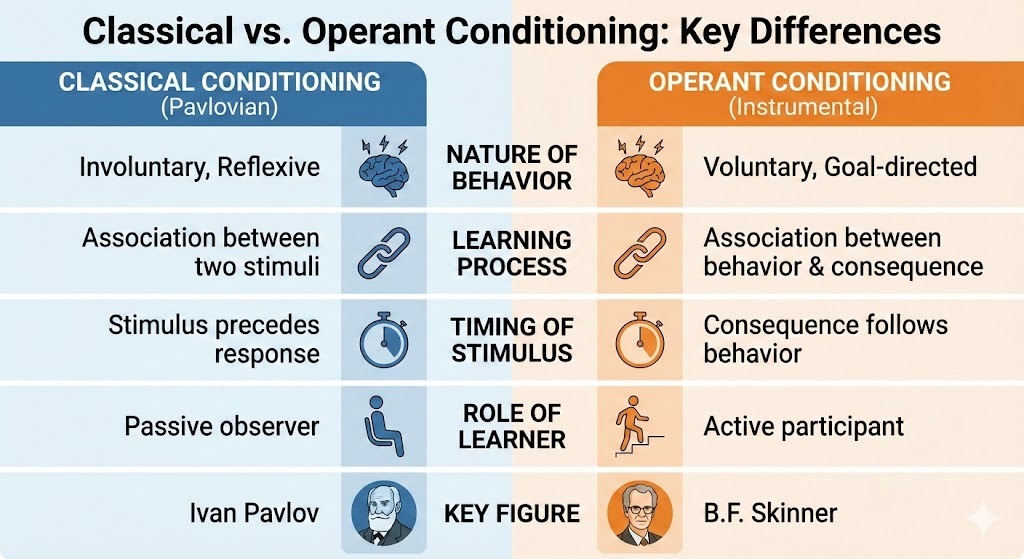
Classical conditioning is passive learning through association. Your brain automatically links two things together, creating involuntary responses. You don’t choose to feel anxious when you hear a dentist’s drill—it just happens because your brain associated that sound with discomfort.
Operant conditioning is active learning through consequences. Your voluntary behaviors are shaped by what happens afterward—rewards encourage repetition, while punishments discourage it. For example, you exercise regularly because you feel energized afterward, or stop checking your phone at dinner because your partner asked you to.
In this guide, we’ll explore operant and classical conditioning differences with real-world examples and show how these principles apply to therapy, parenting, and daily life.
Understanding the Basics of Classical and Operant Conditioning
Two foundational learning methods—classical conditioning and operant conditioning—lie at the heart of behavioral psychology. Though often confused, they guide behavior in very different ways.
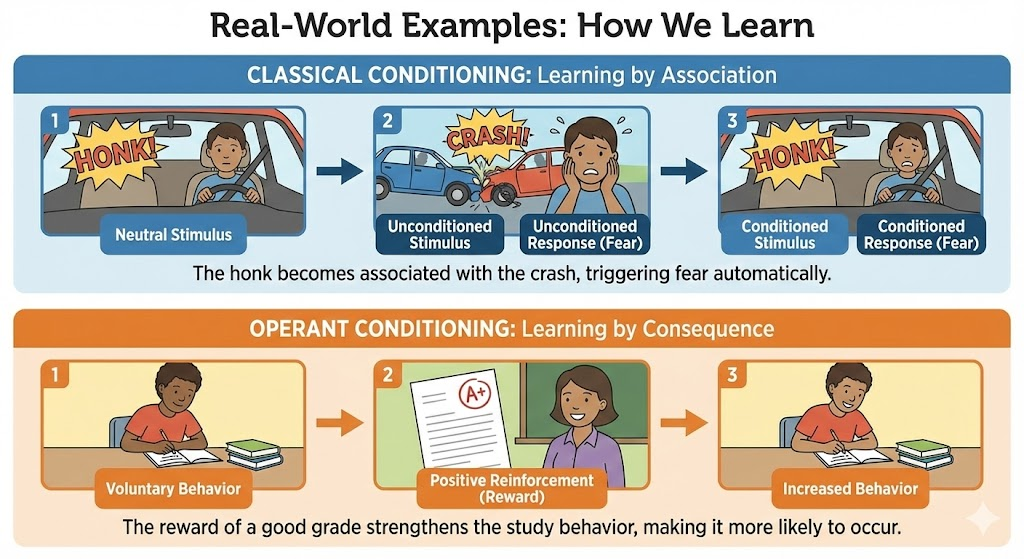
Classical conditioning centers around associations. Pavlov’s experiment with dogs famously illustrated how a neutral stimulus, like a bell, when repeatedly paired with an unconditioned stimulus, like food, can eventually trigger a conditioned response, such as salivation. This automatic response becomes wired into behavior without conscious effort.
Operant conditioning is about consequences. B.F. Skinner’s work showed how behaviors are shaped by reinforcement and punishment. A child praised for doing homework is more likely to repeat the behavior, while one scolded for drawing on walls may learn to stop.
Both types appear in everyday life, therapy techniques, and classroom systems—influencing everything from our emotional reactions to our daily habits.
Key Differences Between Classical and Operant Conditioning
| Aspect | Classical Conditioning | Operant Conditioning |
| Type of Learning | Learning by association | Learning by consequence |
| Learner’s Role | Passive (automatic response) | Active (voluntary behavior) |
| Timing | Stimulus comes BEFORE response | Consequence comes AFTER behavior |
| Response Type | Involuntary and automatic | Voluntary and intentional |
| Key Process | Pairing a neutral stimulus with a meaningful stimulus | Linking behavior with reward or punishment |
| Famous Example | Pavlov’s dog salivates at bell sound | Skinner’s rat presses the lever for food |
| Real-Life Example | Feeling anxious hearing the dentist drill | Studying harder after receiving praise |
| Therapy Application | Exposure therapy for phobias | Behavioral activation for depression |
Stimulus and Response: The Building Blocks of Learning
Every learned behavior—pulling your hand from heat or checking your phone at a notification—begins with a stimulus and response. These elements form the foundation of both classical and operant conditioning and define how we react to our environment.
In classical conditioning, the stimulus comes first, eventually triggering an involuntary response. In operant conditioning, the focus is on the consequence following a response, which reinforces whether the behavior repeats.
Key points about stimulus-response patterns:
- A stimulus is any event that evokes a response (sound, sight, action)
- A response is the behavior triggered by that stimulus
- Repeated pairings make the connection automatic
- Stimuli can be internal (thoughts) or external (bells, commands)
- Responses can be reflexive (flinching) or learned (typing a password)
- The strength of learned behavior depends on the frequency and consistency of pairing
How Association Drives Behavioral Conditioning
Associations form the core of behavioral learning. Whether a pet expects treats after hearing a jar open or someone feels anxious before public speaking, these connections teach us what to expect and how to act.
In classical conditioning, associations occur when a neutral stimulus is paired with something meaningful. In operant conditioning, the association forms between behavior and its consequence.

Examples of association in action:
- Pairing a sound with food creates a conditioned response (dog salivates to bell)
- Consistently rewarding a child after homework builds a positive behavior loop
- Negative outcomes (headache after loud noise) teach avoidance
- Emotional associations form, like fear linked with specific situations
- With repetition, associations strengthen and become harder to unlearn
Examples in Everyday Life
Classical Conditioning Examples:
Food Aversions: Get sick after eating something? Your brain creates an automatic aversion, even if the food wasn’t the cause.
Emotional Responses to Sounds: An ex’s ringtone triggers anxiety months after a breakup because your brain paired the sound with emotional distress.
Morning Coffee Ritual: Feeling alert from just smelling coffee brewing—your body anticipates the caffeine before you drink it.
Test Anxiety: Feeling nervous entering a classroom where you previously took difficult exams.
Operant Conditioning Examples:
Parenting: A child cleans their room and earns stickers toward a park trip—positive reinforcement strengthens the behavior.
Workplace Bonuses: Sales teams work harder during bonus months because extra effort leads to extra income.
Exercise Habits: You return to the gym regularly because you feel energized afterward—the positive outcome reinforces the behavior.
Traffic Routes: After getting stuck on Main Street three times, you switch to Elm Street—punishment decreased one behavior while relief reinforced the new route.
Reinforcement in Operant Conditioning: Positive Vs Negative
In operant conditioning, reinforcement increases the likelihood of behavior repetition. But reinforcement isn’t always about rewards—sometimes it’s about removing something unpleasant.
| Type of Reinforcement | Definition | Example |
| Positive Reinforcement | Adding a desirable stimulus to increase behavior | Giving a dog a treat for sitting on command |
| Negative Reinforcement | Removing an unpleasant stimulus to increase behavior | Turning off loud music when homework is done |
The Role of Punishment in Shaping Behavior
Where reinforcement increases behavior, punishment decreases it. Punishment introduces consequences that discourage repetition, but must be used carefully—too harsh or inconsistent, and it may backfire.
Key concepts about punishment:
- Positive punishment adds an unpleasant outcome (scolding) to reduce behavior
- Negative punishment removes something desirable (screen time) to reduce behavior
- The goal is behavior suppression, not retaliation—consistency matters
- Punishment works best when paired with reinforcement for desired behaviors
- Overuse without positive strategies can lead to anxiety or mistrust
How Consequences Influence Learning Outcomes
Every consequence sends a message: “Do this again” or “Avoid this next time.” Through this feedback loop, behavior is shaped, solidified, or extinguished.
How consequences drive learning:
- Immediate feedback strengthens the behavior-consequence link
- Clear, predictable consequences build trust and understanding
- Reinforcement encourages repetition; punishment discourages recurrence
- Variable rewards (surprise praise) can motivate more than fixed ones
- Intentional consequences guide long-term behavior patterns
Practical Applications: Real-World Uses
Understanding classical vs operant conditioning shapes therapeutic approaches, educational strategies, and personal development.
Mental Health and Therapy
Classical Conditioning Applications:
- Exposure therapy for phobias gradually presents feared stimuli in safe contexts, breaking the fear association
- Systematic desensitization pairs relaxation with anxiety triggers, helping those with anxiety disorders
Operant Conditioning Applications:
- Behavioral activation for depression encourages activities that bring joy, creating positive reinforcement loops
- Token economy systems in intensive outpatient programs reward treatment engagement
- CBT helps identify behaviors leading to positive outcomes
Education and Parenting
In Classrooms:
- Positive reinforcement: praise, gold stars, extra recess for completed work
- Creating positive associations with subjects through engaging early experiences
- Token economies where class points lead to group rewards
In Parenting:
- Bedtime routines signal sleep time (classical)
- Sticker charts and privileges reward good behavior (operant)
- Consistency is key—random consequences confuse learning and create anxiety
Self-Improvement
Apply these principles to change your own behavior:
- Create routines that trigger desired mental states (classical)
- Track progress and celebrate small wins (operant)
- Change environments to break unwanted associations
- Use habit stacking: reward yourself after completing desired behaviors
Real-Life Comparison
| Situation | Classical Conditioning | Operant Conditioning |
| Training a Dog | Dog salivates at bell associated with food | Dog sits and gets treat for doing so |
| Child in School | Student feels anxious hearing school bell before test | Student earns extra playtime for completing homework |
| Workplace Behavior | Feeling stressed entering meeting room due to past conflicts | Employee gets bonus for meeting quarterly goals |
| Daily Habits | Craving coffee when smelling it brewing | Making bed daily to avoid parents’ scolding |
| Emotional Responses | Feeling happy hearing song associated with good memories | Avoiding traffic routes after repeated delays |
Understanding Classical and Operant Conditioning: Your Path Forward
Whether you’re a student, parent, or someone interested in personal growth, grasping the classical and operant conditioning differences empowers you to understand why we do what we do.
Key distinctions to remember:
Classical conditioning shapes automatic, involuntary responses through association—emotional reactions, phobias, comfort responses happen passively.
Operant conditioning molds voluntary behaviors through consequences—work habits, social behaviors, and skill development happen actively through reinforcement and punishment.
Both surround us daily, influencing emotions, decisions, habits, and relationships. Understanding these principles opens pathways to change. If you struggle with anxiety, phobias, or unwanted patterns, evidence-based therapies rooted in conditioning can help.
At Treat Mental Health, we apply these scientifically-proven concepts through exposure therapy, behavioral activation, and CBT to help clients overcome anxiety, depression, PTSD, and more.
Ready to explore how these principles can support your mental health journey? Contact Treat Mental Health or verify your insurance to get started.
FAQs
What is the difference between stimulus and response in classical vs operant conditioning?
In classical conditioning, a stimulus triggers an automatic response through association, like salivating at the smell of food. In operant conditioning, the response comes first, and the stimulus (a consequence like a reward or punishment) follows to reinforce or discourage the behavior.
How do positive and negative reinforcement affect learning in operant conditioning?
Positive reinforcement adds something pleasant (like praise) to encourage behavior, while negative reinforcement removes something unpleasant (like a loud noise) to achieve the same result. Both aim to increase the likelihood of the behavior recurring.
In what ways does punishment serve as a consequence in both classical and operant conditioning?
Punishment is primarily used in operant conditioning to reduce unwanted behavior through unpleasant outcomes. It isn’t a central concept in classical conditioning, which focuses on associations rather than consequences.
How does the association between stimulus and response contribute to behavioral adaptation?
When someone repeatedly experiences a stimulus followed by a specific outcome, the brain forms associations that guide future behavior. Over time, these associations shape habits, emotional responses, and coping strategies.
What are the key differences in the consequences of behavior in classical conditioning compared to operant conditioning?
Classical conditioning doesn’t involve consequences—it builds automatic responses to stimuli. Operant conditioning relies on consequences (rewards or punishments) to teach whether a behavior should be repeated or avoided.